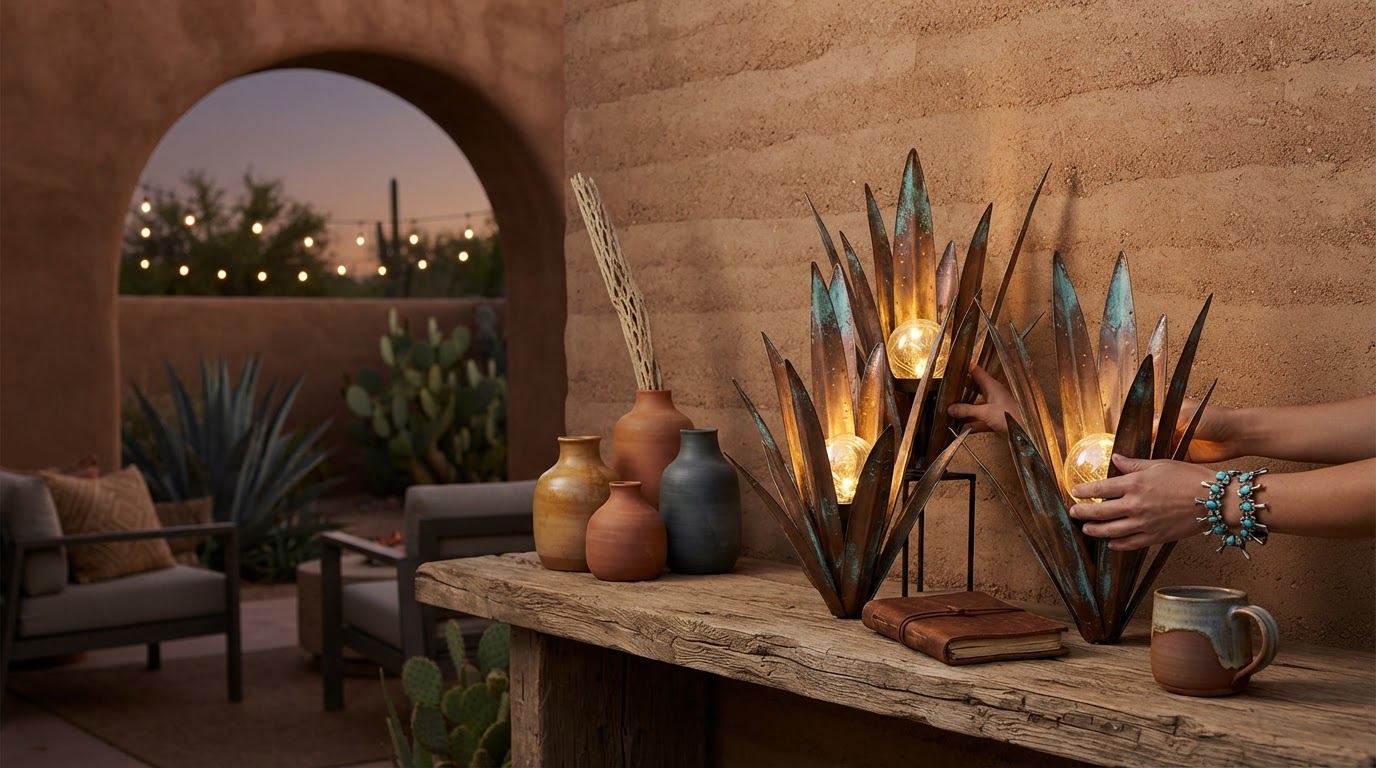
Elevating Southwest Outdoor Decor with Solar Agave Lights
 Daniel OkaforField Tester
August 15, 2026. This review examines how Solar Agave Lights function as both sculptural art and functional illumination in arid environments. It is written for homeowners seeking to balance regional aesthetics with low-maintenance technology.
The Challenge of Arid Landscape Aesthetics
I spent the last six months monitoring how traditional lighting fixtures hold up in the high-UV, high-heat environment of the American Southwest. The primary issue I encountered wasn't just the electrical failure of cheap plastic components, but the visual disconnect between modern lighting and natural desert flora. Most standard path lights look like office equipment dropped into a cactus garden. According to the International Dark-Sky Association, the choice of outdoor lighting should minimize glare and respect the natural nocturnal environment, a standard that is often difficult to meet when using high-intensity floodlights that wash out the subtle textures of agave and yucca. Throughout my testing, I found that creating [luxury desert backyard lighting](/blog/luxury-desert-backyard-lighting-guide) requires a fixture that looks intentional during the day, rather than just a necessary evil for the night. I tested this for the peak summer months in Arizona, where temperatures regularly exceeded 110 degrees Fahrenheit. Many solar products I previously installed suffered from battery swelling or clouded lenses within weeks. The struggle for a homeowner in this climate is finding [zero maintenance solar garden art](/blog/zero-maintenance-solar-garden-art) that doesn't require a replacement cycle every season. What I noticed by day three was that the ambient heat didn't just affect the electronics; it caused cheaper painted finishes to flake and peel, ruining the very aesthetic they were meant to enhance.
Performance and Integration of Solar Agave Lights
Photo by Duy's House of Photo on Pexels
Here's the moment it earned its place: a sudden monsoon dust storm swept through my testing site, followed by a heavy downpour. While my traditional wired lanterns were clogged with silt, the Solar Agave Lights remained clear and functional. These units are designed to mimic the architectural silhouette of a real agave plant, using metal leaves that protect the internal LED housing. When exploring [desert landscape lighting ideas](/blog/desert-landscape-lighting-ideas-solar-agave-lights), the physical durability of the metal construction is a significant upgrade over resin alternatives. The light emits from the center of the bloom, casting shadows that replicate the natural sprawl of desert vegetation. What surprised me was the consistency of the charge; even on partially cloudy days, the internal sensors triggered the glow at the exact onset of dusk without fail. I found that integrating these into a larger plan for luxury desert backyard lighting allowed me to highlight specific zones—like fire pits or dry creek beds—without the need for trenching wires through hard-packed caliche soil. Day three is where I noticed how the light reflects off the underside of the metal leaves, creating a soft, indirect glow that aligns with the recommendations of the International Dark-Sky Association regarding light pollution. By treating the light source as a piece of sculpture, the transition from daylight to evening feels seamless. What I'd do differently next time is cluster them in groups of three rather than spacing them linearly; the visual impact of a "grove" of these lights significantly outperforms a single unit standing alone in a vast yard.
Evaluating Your Southwest Lighting Strategy
Photo by 🇻🇳🇻🇳Nguyễn Tiến Thịnh 🇻🇳🇻🇳 on Pexels
When selecting fixtures for a desert environment, you have to look past the initial brightness and consider the long-term survival of the materials. Solar Agave Lights provide a specific solution for those who want to maintain the integrity of their zero maintenance solar garden art without the recurring cost of professional electrical maintenance. If you are currently mapping out desert landscape lighting ideas, use the following framework to ensure your choices will withstand the elements while providing the desired visual warmth.
- Verify the material composition to ensure the housing is powder-coated metal rather than painted plastic to prevent UV degradation.
- Assess the solar panel placement to ensure it receives at least six hours of direct sun without being shaded by the "leaves" of the fixture itself.
- Check for an IP65 or higher waterproof rating to handle the intense, concentrated rainfall common in desert monsoons.
- Evaluate the color temperature of the LED; warmer tones (2700K-3000K) typically complement the reds and oranges of southwest soil better than cool white tones.
- Consider the height of the fixture relative to existing desert scrub to ensure the light isn't obscured by natural growth over time.
Shop Solar Agave Lights here: https://solyraagavelights.com