Solar Agave Lights for Sustainable Desert Gardening
 Priya RamanSenior Analyst
October 5, 2026. This analysis examines the integration of artificial luminous elements within arid ecosystems to promote year-round visual interest without taxing local resources. It is designed for homeowners and landscape designers seeking to balance modern lighting technology with the delicate requirements of low-water environments.
To effectively implement lighting in these regions, think of it as a matrix of biological preservation and architectural enhancement. The two axes that matter here are environmental impact and structural durability. In many arid regions, traditional landscaping often conflicts with the natural habitat. According to Yale E360, the Mojave Desert is teeming with life, including rare species like the threecorner milkvetch, which thrive in what may appear to be barren soil. When planning outdoor solar desert plants, the primary challenge is introducing light without disrupting the nocturnal rhythms of local fauna or the growth cycles of native flora. Research published by the California Energy Commission in their report on Desert Plant Response to Solar Energy Development indicates that industrial-scale solar infrastructure can have adverse effects on desert plants; however, residential-scale, self-contained units like Solar Agave Lights offer a non-invasive alternative. These units do not require the trenching or extensive cabling that often damages the fragile root systems of established cacti and succulents. By utilizing standalone desert landscape solar lighting ideas, property owners can avoid the soil compaction and thermal disturbances associated with traditional high-voltage grid connections. The goal is to mimic the architectural silhouette of the agave while providing illumination that does not interfere with the natural desert landscape solar lighting ideas already present in the native terrain.
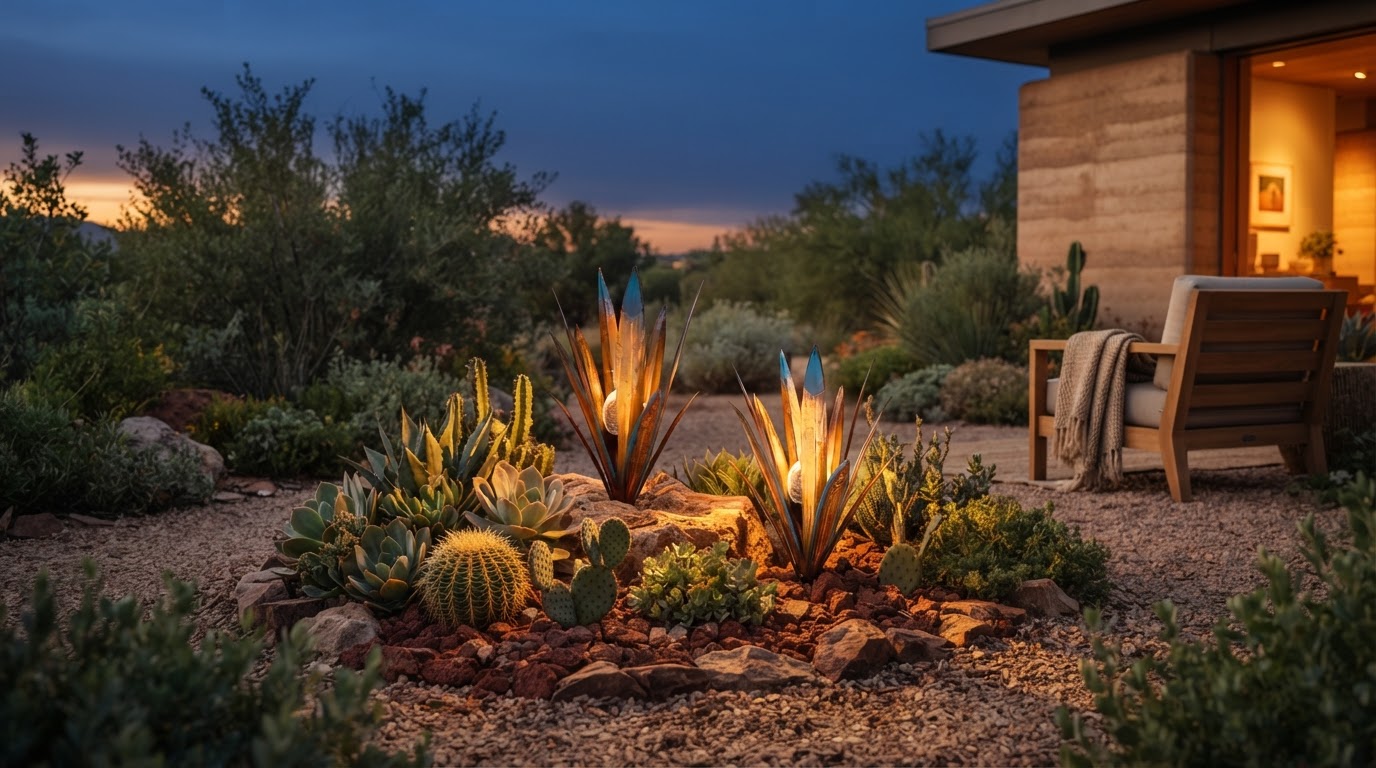
Solar Agave Lights address these environmental constraints through a design that prioritizes both form and function. These fixtures capitalize on the high solar irradiance characteristic of desert climates to power integrated LED systems, eliminating the need for external energy consumption. The construction typically features metal agave yard art solar components, which provide a permanent structure that does not require the irrigation or maintenance of live succulents. This is particularly relevant in areas where water scarcity is a primary concern. A report from the Desert Research Institute (DRI) highlights how focused sustainability efforts can lead to significant ecological recovery, noting that a site saw an increase from 12 to 93 rare plants following targeted conservation measures. By opting for light-up agave plant garden features instead of high-maintenance exotic flora, homeowners contribute to this broader conservation goal. The metal cactus decor with lights provides a consistent visual anchor even during periods of extreme drought when live plants may enter dormancy or show signs of stress. Once you see it this way, the choice between live high-water plants and sustainable light-emitting sculptures becomes a matter of long-term ecological stewardship. These fixtures are designed to endure the high UV exposure and temperature fluctuations of the desert, ensuring that the outdoor solar desert plants aesthetic remains intact without the risk of plant loss or the need for chemical fertilizers that could leach into the surrounding desert landscape solar lighting ideas.
Selecting the appropriate fixture requires a structured decision framework based on three primary dimensions: light temperature, material resilience, and placement density. The decision rule is to prioritize fixtures that offer a warm color temperature (2700K-3000K) to minimize light pollution and maintain a naturalistic desert ambiance. When evaluating options, consider the following technical checklist:
- Lumens output: Ensure the intensity is sufficient for pathway safety but low enough to prevent glare against the dark desert sky.
- Material finish: Look for powder-coated metals that resist oxidation in high-alkalinity environments.
- Battery capacity: Verify that the internal storage can sustain 8-10 hours of light following a standard desert sun cycle.
- Base stability: Choose designs with reinforced ground stakes to withstand high-velocity desert winds.
- Aesthetic integration: Match the leaf structure of the light to existing native agave species to maintain visual harmony.
Sources
Photo by JINU JOSEPH on Pexels
- A Rare Desert Plant Shows Benefits of Sustainability Efforts at a Large ...
- Mojave Solar Farm a Haven for Rare Desert Plant - Yale E360
- Desert Plant Response to Solar Energy Development