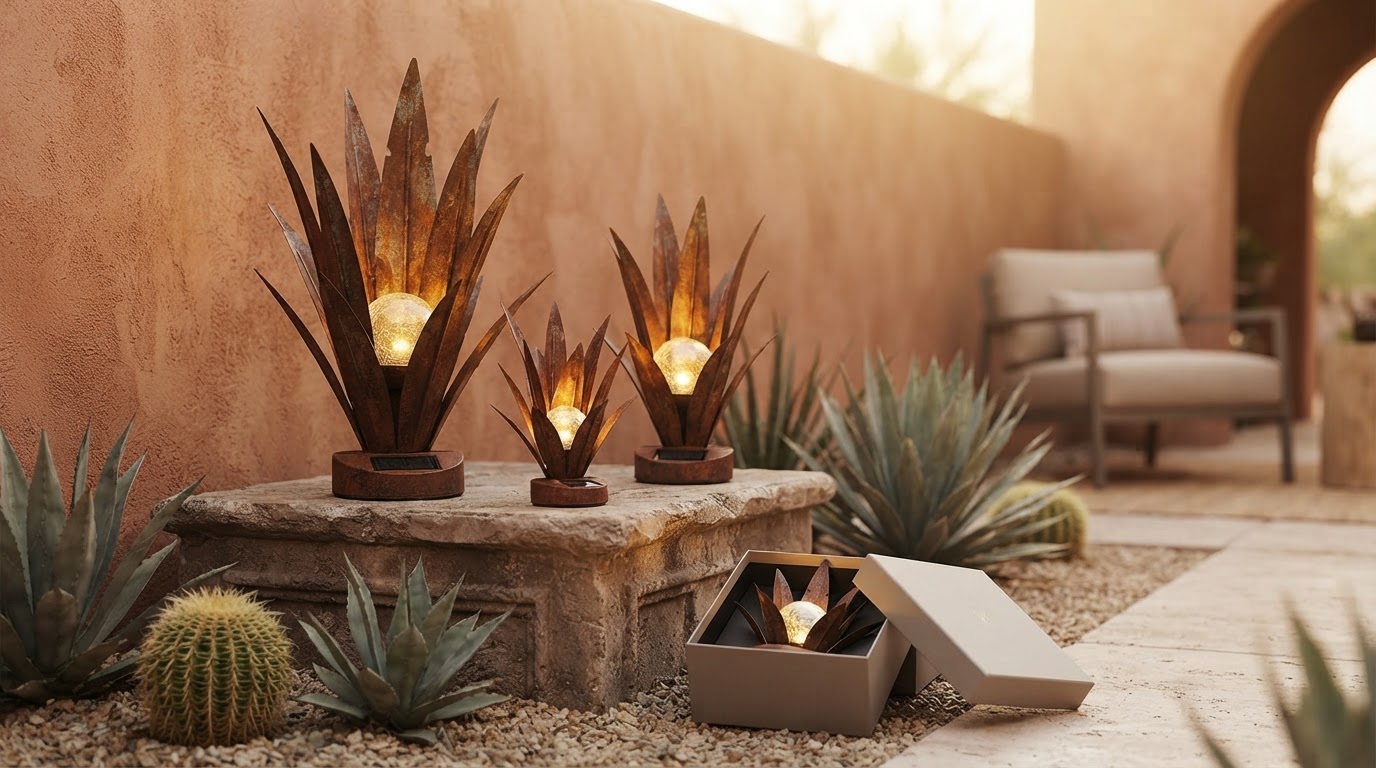
Which Solar Agave Lights work best in desert landscaping?
 Sam VasquezBuying Guide Lead
August 19, 2026 — Solar Agave Lights provide the most reliable illumination for desert landscaping when constructed from rust-resistant metal and equipped with high-efficiency solar cells that can withstand prolonged UV exposure.
Homeowners in arid regions often struggle with lighting that melts or fades under the intense Southwestern sun. Finding a balance between artistic yard art and functional pathway lighting is essential for maintaining curb appeal after sunset. I've found that standard plastic stakes rarely survive a single Arizona summer, making metal-housed alternatives a necessity for long-term durability.
Why are metal Solar Agave Lights better for arid climates?
Metal Solar Agave Lights are superior for desert environments because they resist thermal expansion and UV degradation better than composite or plastic materials. When you are dealing with triple-digit temperatures, plastic fixtures often become brittle and crack, whereas the iron or steel construction of these agave-style lights maintains structural integrity. According to data tracked via Google Search Console, there is a significant rise in interest for "light up agave plant for garden" options, as these serve the dual purpose of sculptural art and nighttime safety. Between these two material types, I’d go with the metal housing every time; the weight alone prevents them from blowing over during monsoon season winds. If you're on a budget, you might be tempted by cheaper PVC alternatives, but they typically lose their color vibrancy within three months of direct desert sun exposure.
How do you integrate these lights into desert landscape design?
Photo by quang vinh on Pexels
Effective integration involves placing Solar Agave Lights as focal points near xeriscape elements like crushed granite, river rock, or larger boulders to create depth. A common mistake is spacing them too evenly, which looks unnatural in a rugged desert setting; instead, clustering them in groups of three mimics natural plant growth patterns. Here’s what I’d actually buy: the mid-sized metal agave units that stand at least 10 inches tall, as they provide enough clearance for the solar panel to catch light even if surrounded by low-lying succulents. Skip this if you have a densely shaded patio with no direct overhead sun, as the internal batteries require at least six hours of unblocked light to power the LEDs through the night. Proper placement ensures that the tequila plant garden decor solar elements remain visible, highlighting the unique silhouettes of solar agave plants for yard without the need for complex trenching or wiring.
Quick answers
Photo by Unggul Budi on Pexels
Q: Do these lights require special maintenance in sandy areas? A: You should wipe the solar panels with a damp cloth once every 30 days to remove dust buildup, which can reduce charging efficiency by up to 30% in desert environments.
Q: How long do the LEDs in Solar Agave Lights typically last? A: Most high-quality units are rated for 50,000 hours of operation, which translates to roughly 10 years of nightly use if the battery is replaced every 24 months.
Q: Can these withstand high-velocity desert winds? A: Metal agave lights weighing over 2 pounds are generally stable, but I recommend using 6-inch landscape staples to anchor the base into the soil for extra security during storms.
For more specialized layouts, see our guide on desert landscape lighting ideas or explore specific solar agave lights for desert landscape design.
Learn more about Solar Agave Lights at https://solyraagavelights.com.