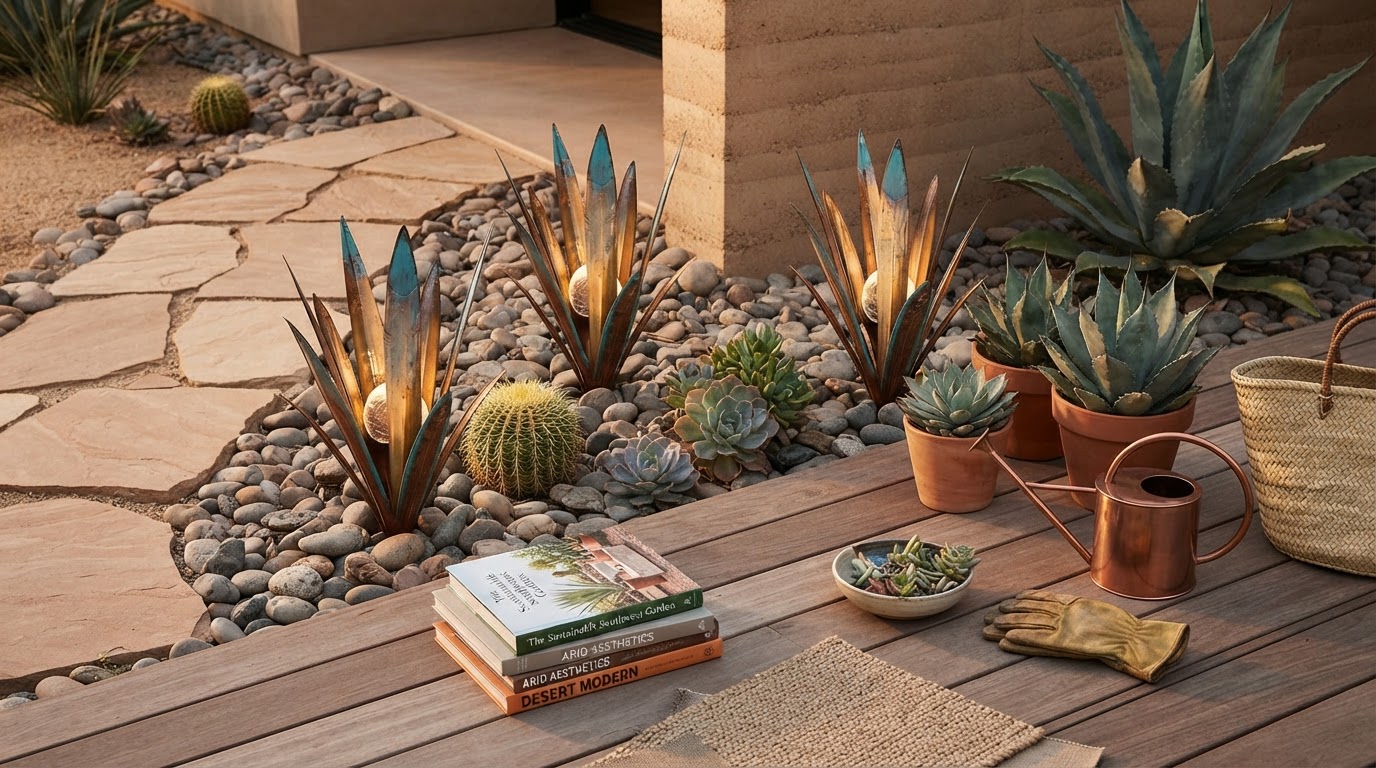
Integrating Solar Agave Lights into Modern Arid Landscapes
 Maya ChenContributing Editor
October 13, 2026. This guide examines the functional integration of metal agave sculptures within sustainable residential landscaping. It is written for homeowners transitioning from high-water ornamentals to durable, light-emitting desert aesthetics.
The Failure of Living Succulents in Pathway Lighting
The conventional wisdom says that a well-maintained desert garden should rely exclusively on organic agave specimens to define borders and walkways. However, this ignores the biological reality of these plants when used in high-traffic or shaded residential zones. According to Planet Desert, while agaves can survive in partial shade, their growth is far more robust when they receive full, direct light. In many modern architectural designs, the very pathways that require illumination are often obscured by structures or larger canopy trees, leading to leggy, unhealthy plants that fail as visual anchors. Furthermore, the physical risk of planting sharp-tipped species like Agave americana near narrow walkways presents a liability that most landscaping blogs gloss over.
Here's the part nobody talks about: the maintenance cost of keeping living succulents in a "perfect" state for pathway aesthetics is rarely offset by their perceived low-water benefits. When a specimen dies or suffers from snout weevil infestation, the visual gap in a agave succulent pathway lights installation is immediate and jarring. The shift toward metal alternatives is not merely a stylistic choice but a response to the fragility of using living organisms as structural lighting foundations. By deploying agave succulent pathway lights made of treated metal, the designer gains control over the geometry and safety of the space without the three-to-five-year replacement cycle typical of stressed succulents. This transition allows for a consistent aesthetic that does not degrade during seasonal shifts or periods of extreme heat that might otherwise scorch organic foliage.
The Engineering of Solar Agave Lights
Transitioning to Solar Agave Lights solves the fundamental conflict between desert aesthetics and nocturnal utility. These units are engineered as dual-purpose installations: they serve as daytime yard art and automated evening illumination. Unlike standard plastic stakes that clutter a garden bed, these metal sculptures mimic the architectural form of the agave plant while housing internal solar components. The technical advantage lies in the integration of the photovoltaic cell; rather than a separate, unsightly panel, the energy collection is often centralized to maintain the silhouette. Research indicates that "light up agave plant for garden" queries have increased as consumers realize that traditional floodlights wash out the intricate shadows of xeriscaped environments.
Run the math: a standard low-voltage wired system requires trenching, a transformer, and a constant draw from the grid. In contrast, a agave succulent pathway lights setup utilizes independent energy nodes. Menards® notes that their metal agave yard art features color-changing LED beads that can be toggled, providing a level of customization that organic plants cannot match. This flexibility is critical when aligning lighting with different architectural styles. The durability of the metal construction ensures that the "plant" remains a permanent fixture, resisting the rot and pest issues inherent in organic gardening. By using these fixtures, you are not just adding a light; you are installing a maintenance-free sculpture that happens to provide 360-degree ambient glow. This is particularly effective when flanking a driveway or defining the transition between a patio and a natural desert wash, where agave succulent pathway lights provide the necessary visual weight to ground the space.
Selecting the Right Sculpture for Your Zone
Choosing the correct Solar Agave Lights requires a departure from purely decorative thinking toward a structural mindset. The size and density of the metal leaves will dictate the shadow pattern cast on the surrounding gravel or pavers. A dense leaf arrangement provides a more diffused, intimate glow, whereas a more open metal structure allows the LED to project further across a path. When evaluating these pieces, prioritize the gauge of the metal and the weatherproofing rating of the solar housing. As seen on Pinterest, waterproof solar garden agave lamps are frequently used as "firefly" accents, but for pathway safety, the height of the light source is the primary metric for success.
To ensure your agave succulent pathway lights serve their functional purpose, follow this technical checklist before installation:
- Verify the lumen output matches the safety requirements of the specific walking surface.
- Match the metal finish (verdigris, rusted, or polished) to existing architectural hardware.
- Ensure the solar panel location receives at least 6 hours of unobstructed sunlight daily.
- Check for an IP65 or higher waterproof rating to withstand irrigation overspray.
- Confirm the base attachment method is suitable for your soil density or concrete substrate.
- Evaluate the color temperature of the LED to ensure it complements the natural desert palette.
Sources
Photo by 🇻🇳🇻🇳Nguyễn Tiến Thịnh 🇻🇳🇻🇳 on Pexels
- Solar Agave Lights - Etsy
- Solar-Powered Metal Agave Plant Garden Light at Menards®
- Agave Succulents 'Care & Growing Guide' Everything You Need To Know