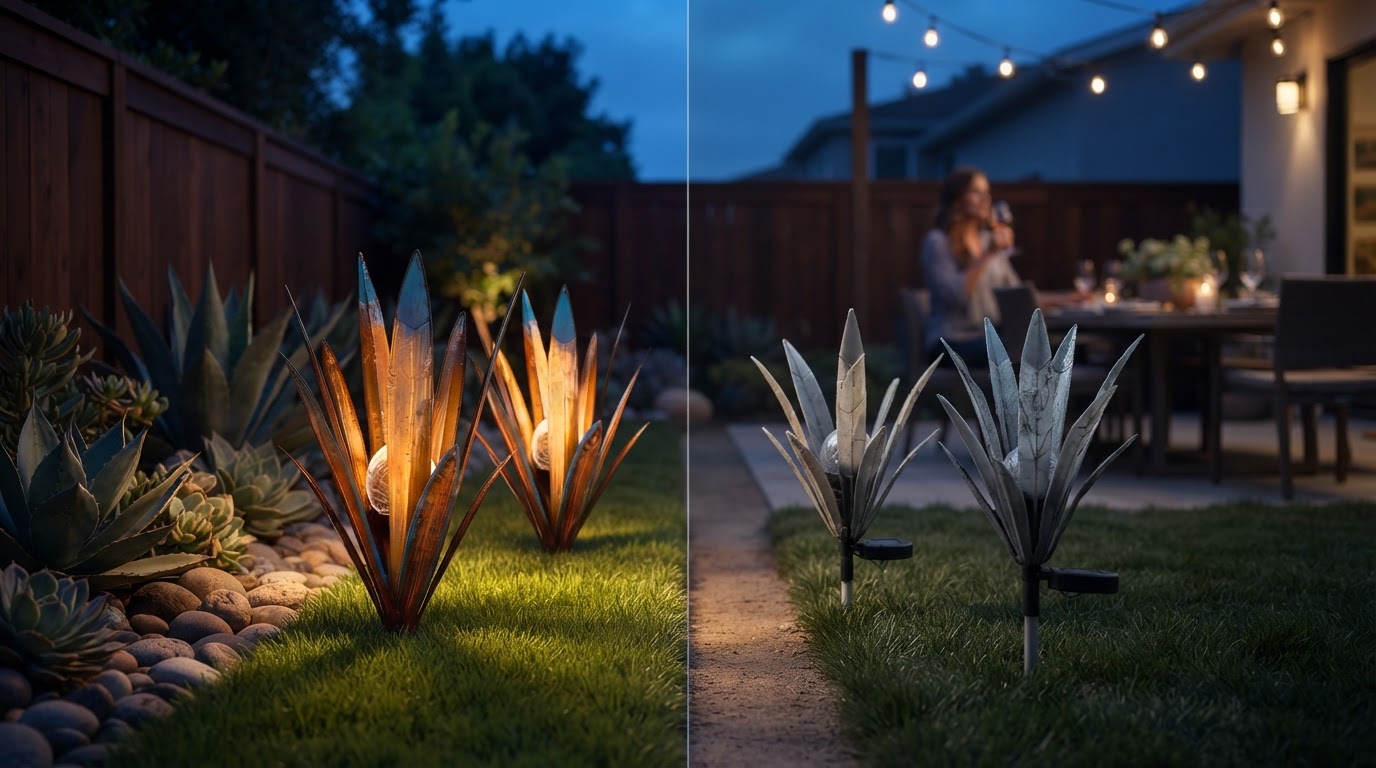
Why choose metal Solar Agave Lights over plastic stakes?
 Maya ChenContributing Editor
August 25, 2026 — Metal Solar Agave Lights offer superior structural integrity and UV resistance compared to plastic alternatives, though they require specific anti-corrosion treatments to maintain their aesthetic profile.
Homeowners frequently prioritize low upfront costs when selecting garden accents, often opting for mass-produced polymer stakes. However, the environmental stressors of high-heat desert climates create a performance gap that standard plastic cannot bridge. The choice between these materials determines whether a fixture remains a functional light source or becomes brittle landscape waste within two seasons.
How does UV degradation impact Solar Agave Lights?
Metal fixtures, specifically those constructed from iron or steel, are immune to the photochemical reactions that cause plastic to become brittle and eventually fracture. The conventional wisdom says that plastic is the 'modern' solution for outdoor gear, but this ignores the reality of polymer chain scission under direct sunlight. When plastic stakes are exposed to consistent solar radiation, the material loses its elasticity, leading to snap-points at the ground level where mechanical stress is highest.
Solar Agave Lights utilize a metal chassis that maintains its tensile strength regardless of UV index levels. While plastic might seem more flexible initially, it lacks the thermal stability required for long-term placement in open garden beds. Run the math: replacing a $15 plastic stake every 18 months is a higher lifetime cost than investing in a single metal agave sculpture that resists structural decay for years. I’ll change my mind when polymer manufacturers can guarantee 10-year color fastness and structural rigidity in Zone 9b heat without significant price inflation.
Do metal solar lights outperform plastic in thermal stability?

Photo by JUNLIN ZOU on Pexels
Metal components provide a more stable housing for internal solar electronics by better managing heat dissipation and resisting thermal expansion. Here's the part nobody talks about: plastic housings expand and contract at rates that often compromise the waterproof seals protecting the internal lithium-ion batteries and LED drivers. This thermal cycling leads to moisture ingress, which is the primary cause of premature solar light failure.
In contrast, Solar Agave Lights are designed as outdoor metal plant statues solar that serve as rigid protective shells. The iron construction acts as a heat sink, preventing the internal battery compartment from reaching critical temperatures that degrade battery capacity. While critics point to the risk of oxidation, modern [rust proof metal garden lights comparison](/blog/rust-proof-metal-garden-lights-comparison) data shows that specialized powder coatings and paint finishes effectively isolate the substrate from moisture, providing a longevity that raw or poorly treated metals cannot match.
Quick answers

Photo by Star Zhang on Pexels
Q: How long do metal solar agave lights last compared to plastic? A: Metal solar agave lights typically maintain their structural form for 5 to 7 years, whereas standard plastic garden stakes often exhibit signs of cracking or fading within 12 to 24 months of exposure.
Q: Are metal agave lights heavier than plastic stakes? A: Yes, Solar Agave Lights constructed from iron weigh significantly more than plastic, providing better stability against wind gusts exceeding 20 miles per hour.
Q: Does the metal get too hot for the solar battery? A: No, the internal housing in Solar Agave Lights is engineered with an air gap that prevents direct thermal transfer from the outer metal leaves to the battery cell, maintaining safe operating temperatures.
Q: Can metal agave lights be used in desert landscaping? A: Metal is the preferred material for outdoor metal agave solar lights in desert environments because it does not warp or melt under surface temperatures that can exceed 120 degrees Fahrenheit.
Learn more about Solar Agave Lights at https://solyraagavelights.com.